 You can increase your lean muscle mass and reduce your overall body fat without dumbbells, barbells, weight
 machines or other resistance equipment, but it will be a challenge. To succeed, you'll need to supplement your diet with some extra protein and incorporate a variety of challenging exercises that use your own body weight for resistance.
Arms
To work your arms successfully, start out with moderately challenging strength exercises and work up to more difficult exercises and higher numbers of reps. Start with push-ups, which tone your chest muscles as well as your arms. Keeping proper form, do as many as you can until you feel fatigued. Each week, try to add five more reps. When you have no trouble doing push-ups, move on to pull-ups and chin-ups using a stable bar.
Legs
Squats and lunges are classic calisthenics exercises that are part of so many workouts because they truly get results despite the fact that they use no weights. Do reps of traditional squats as well as prisoner squats, with your hands locked behind your head, and one-legged squats when you build up your strength. Work on both forward and backward lunges as well as side lunges, which ExRx.net says will tone both the hips and the gluteus maximus. Step-ups will also challenge your legs without weights. Start with stepping onto a stool about 12 inches in height, and then move on to higher and higher steps.
Midsection
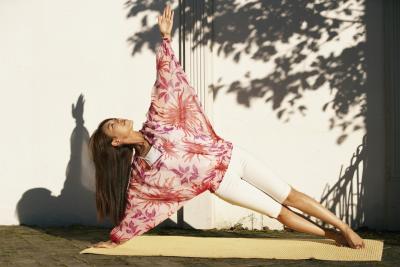
The Mayo Clinic states that in addition to toning abdominal and stomach muscles, core exercises improve posture, balance and stability, and make it easier to complete vigorous aerobic activity. If you've mastered the traditional crunch, add an element of extra challenge with bicycle crunches, which also work oblique muscles and further raise the heart rate. You can also work on pike crunches, for which you lie on your back, keep your legs and arms straight and crunch upward from the abs to meet your fingers and toes. Finally, work on holding a front and side plank pose for at least 60 seconds or as long as you can.
Chest and Back
If you have access to a dip bar, use it to practice chest dips. Dips target the pectoralis major as well as secondary back muscles. Chin-ups and pull-ups also work the back. Finally, experiment with push-up hand positions to further challenge chest muscles, and try elevating your feet to make the movement more difficult. A 2005 Mayo Clinic study published in the "Journal of Strength & Conditioning Research" found that narrow hand positioning for push-ups encouraged the greatest muscle activation throughout the body.


